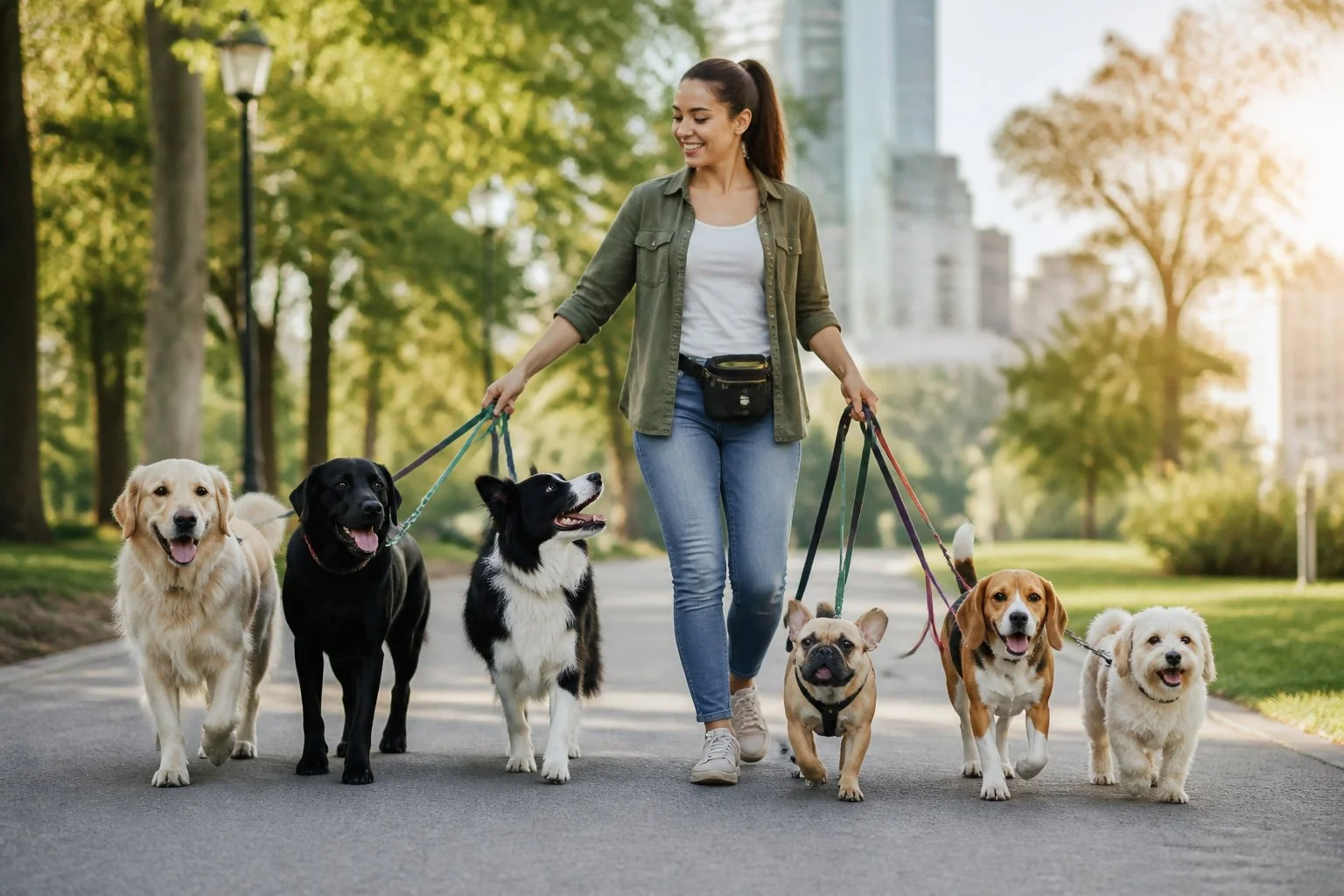
Some dogs come home from a group walk and crash out for hours. Owners often read that as a good, tiring walk. Sometimes it is. Other times it is a dog recovering from being overwhelmed.
I’m Derek Collinson, and I run K9 Time in Sheffield. I’ve spent more than 25 years around dogs, and I only ever offer solo, one-to-one walks. Never mixed packs. That choice comes from watching how differently dogs behave when they aren’t managing five other personalities at once.
When people compare a solo dog walker vs group walks, the honest answer is that the best option is the one that suits your dog’s temperament, not the one that looks the most sociable. Some confident dogs genuinely enjoy company. Plenty of others just cope.
If you’re in S7, S8, S10, S11 or S17 and you’re not sure which camp your dog falls into, I’d love to chat it through with you over a free 30-minute meet and greet. No obligation, just a friendly conversation about your dog.
Key Takeaways
-
Excitement on a walk isn’t the same thing as enjoyment, and stress can look like both frantic behaviour or complete withdrawal.
-
Solo walks let the pace, route and length shift around one dog rather than a whole group.
-
Temperament matters far more than breed when deciding which walking arrangement fits.
How Each Walking Arrangement Works
The practical differences come down to attention and control. A group walk splits a walker’s focus across several dogs from different homes, while a one-to-one walk keeps everything centred on one dog or one household.
What Owners Can Expect From Group Dog Walks
Group dog walks usually involve a professional dog walker collecting several dogs, transporting them together, then walking them as one group.
Everyone follows roughly the same plan. The same route, the same pace, the same length. That works if all the dogs are well matched.
It’s worth asking any dog walking service how groups are put together, how many dogs travel at once, whether each dog has a secure individual space in the vehicle, and what happens when two personalities clash.
What One-to-One Walks Give an Individual Dog
On solo dog walks, I’m reading one dog. I can see when a dog is limping slightly, worrying about traffic, getting fizzy near another dog, or simply asking to sniff a hedge for another minute.
The walk can then change. I can cross the road early, add distance, slow right down, or extend a sniffing session.
At K9 Time I walk one dog at a time, or up to three dogs from the same household. Those dogs already live together and share a routine, so nothing new is being forced on them.
Matching the Walk to Your Dog’s Needs
People often ask me: are group dog walks good? My answer is that it depends entirely on the individual dog in front of me, and breed tells me far less than behaviour does.
When a Carefully Managed Group May Be a Good Fit
Some dogs really do thrive in company. Typically these are dogs with solid recall, calm travel manners, a fair play style and no guarding habits around toys, water or food.
A well-matched, small, closely supervised group can suit that sort of dog. The key words are small and well matched.
If a walker can’t tell you how they pair dogs up, that’s a fair reason to pause.
Why Sensitive Dogs Often Benefit From Individual Attention
Puppies learning lead skills need repetition and patience, not a crowd. Young puppies especially need careful, gradual exposure before meeting lots of unfamiliar dogs.
Older dogs and senior dogs often need a steady pace, more rest stops and shorter distances. Being pulled along by a busy group isn’t kind to stiff joints.
Dogs rebuilding confidence after a bad experience also do better with one person concentrating solely on them.
Why Breed Is Less Important Than Temperament
I’ve walked Labradors who wanted nothing to do with strange dogs, and spaniels who found group noise deeply unsettling.
I’ve also met retrievers with a reputation for being easy-going who were simply exhausted by constant company.
Breed gives you a rough hint about energy and drive. It tells you very little about how a particular dog copes with pressure, and that’s the part that matters on a walk.
Signs a Group Setting May Be Too Much
Stress doesn’t always look dramatic. With reactive dogs, nervous dogs and anxious dogs, group dog walks can produce either a very loud response or a very quiet one, and the quiet one is easier to miss.
Hyper-Vigilance
A hyper-vigilant dog can’t settle into the walk. The head is up, the eyes scan constantly, and every noise or movement gets checked.
You might notice a stiff body, a tucked or high tight tail, panting when it isn’t warm, or a dog who won’t take a treat they’d normally love.
That dog isn’t relaxing. They’re on duty.
Frantic Behaviour and Reactivity
Some dogs get faster and louder instead. Barking, lunging, spinning on the lead, mouthing at other dogs or grabbing their own lead.
Owners sometimes describe this as being “over-excited” and playful. Often it’s frustration or worry with nowhere to go.
Once a dog tips into that state, they struggle to come back down for the rest of the walk.
When a Dog Cannot Sniff, Explore or Decompress
Sniffing is how dogs process the world, and it genuinely calms them. A group walk that keeps moving to keep everyone together leaves little room for it.
If your dog never gets to stop, investigate and make their own choices, they’re getting exercise without decompression.
That’s a big part of why some dogs come home wired rather than settled.
Shutting Down and Other Quieter Signs of Stress
The dog I worry about most is the one who goes quiet. Trailing behind, freezing, hiding behind the walker’s legs, refusing to get in the van, or turning away from other dogs.
Yawning, lip licking, shaking off when dry and low ears all fit here too.
A “well-behaved” dog on a group walk is sometimes just a switched-off one.
The Practical Benefits and Limits of Both Options
I don’t think one format is automatically better. Both solo dog walks and group dog walks have real strengths and real limits, and the solo vs group dog walks decision usually comes down to what your dog actually needs from their dog walks.
Social Contact, Exercise and Stimulation in a Group
For the right dog, a group offers movement, play and company. Sociable dogs with good manners can genuinely enjoy that.
The limit is that everything runs at group speed. If your dog needs to slow down, hang back or avoid something, the group can’t always accommodate that.
There’s also more going on for the walker to manage at any one moment.
Pace, Route and Routine on a Solo Walk
On a solo walk, small things become easy. Water breaks, quieter roads, extra distance from a barking garden dog, a shorter loop on a hot day.
I can use the same cues and handling on every visit, which helps dogs learn what to expect from me.
|
What changes |
Group walk |
Solo walk |
|---|---|---|
|
Pace and distance |
Set for the group |
Set for your dog |
|
Route choice |
Fixed |
Adjusted on the day |
|
Sniffing time |
Limited |
As needed |
|
Trigger management |
Shared attention |
Full attention |
Why Excitement Does Not Always Mean Enjoyment
A tail-wagging, bouncing dog isn’t always a happy dog. High arousal and stress can look almost identical from the outside.
The better test is what happens afterwards. Does your dog settle calmly within twenty minutes or so, or pace, pant and struggle to switch off?
Recovery tells you more than the first thirty seconds ever will.
K9 Time’s Calm One-to-One Approach in Sheffield
My dog walking service is built around one idea: a professional dog walker should be able to give your dog undivided attention. That’s why I only offer solo dog walks, which suits anxious dogs, reactive dogs and senior dogs particularly well.
Tailored Walks for Anxious, Reactive and Senior Dogs
Every walk is planned around your dog’s energy level, behaviour and needs. Walks run for either an hour or half an hour, and some households mix the two.
For a nervous dog, I’ll choose open routes with good visibility so we can create distance before anything becomes a problem.
For an older dog, we go at their speed, with plenty of stops. No dog is ever rushed to keep up with anyone else.
A Holistic, Reassuring Approach From Derek
Alongside more than 25 years of dog care experience and over 40 years with cats, I’m a Certified Usui Reiki Master and trained in dog first aid.
That background shapes how I handle dogs day to day. Calm energy, slow movements, quiet voice and patience rather than pressure.
I’m also fully insured, DBS checked and a registered member of NARPS UK.
GPS Tracking and App Updates for Owner Peace of Mind
Every walk is GPS-tracked, so you can see exactly where we went. You’ll get a walk report through a free mobile app, along with photos and videos.
That means you know how long we were out, how your dog behaved and whether anything unusual happened.
For owners at work all day, that little update makes a real difference.
Choosing the Right Start for Your Dog
Picking a dog walker isn’t just about availability and price. A few honest questions about your dog’s habits will point you towards the right kind of dog walking arrangement.
Questions to Consider Before Booking
Have a think about the following:
-
How does your dog behave around unfamiliar dogs on lead?
-
Are they comfortable travelling in a vehicle with dogs they don’t know?
-
Do they settle well within half an hour of getting home?
-
Do puppies or older dogs in your home need a slower, gentler pace?
-
Is there medication, a health issue or specific handling to consider?
A good walker should tell you honestly if their service doesn’t fit those needs. I’d rather refer someone elsewhere than take on a dog I can’t do right by.
Book a Free Meet and Greet With K9 Time
I offer a free 30-minute meet and greet with no obligation at all. We’ll sit down, I’ll meet your dog, and you can tell me about their routine, quirks and worries.
I cover Sheffield postcodes S7, S8, S10, S11 and S17, including Totley, Dore, Bradway, Fulwood, Nether Edge, Crookes, Millhouses and Ecclesall.
Dog walking is £26 per hour or £20 per half hour. If you’d like a friendly, no-pressure chat about what your dog needs, give me a call and we’ll get something in the diary.
Frequently Asked Questions
Are group dog walks a good idea for my dog?
They can work well for confident, sociable dogs with reliable recall who travel calmly and share a fair play style. They’re a poorer fit for nervous, reactive or older dogs who need space and a slower pace. The dog’s temperament matters far more than the format itself.
How do I know whether my dog would prefer one-to-one walks?
Watch how your dog behaves before, during and after a walk. Reluctance to leave, constant scanning, frantic lead behaviour, or an inability to settle afterwards all suggest they’re finding something too much. Dogs who need extra time to sniff and decompress usually do better one-to-one.
Are solo walks better for reactive or nervous dogs?
Usually, yes. A solo walk means one person can concentrate fully on creating distance and making safe decisions without also managing several leads. No format guarantees your dog will never meet a trigger, but the response can be much quicker and calmer.
How many dogs can a professional dog walker walk at once?
That varies between walkers, and there’s no single rule. At K9 Time I walk one dog at a time, or up to three dogs from the same household, because they already live and travel together. I never mix dogs from different homes.
Do dogs get enough exercise and socialisation on group walks?
Group walks can deliver plenty of movement and company, but dogs don’t need to greet every dog they meet to have a good walk. Calmly watching people, traffic, birds and other dogs from a comfortable distance is real socialisation too. Sniffing, movement and steady one-to-one company provide rich stimulation.
What should I ask a dog walker before choosing a walking service?
Ask how many dogs they walk together, how dogs travel, what insurance and checks they hold, and whether they’re trained in dog first aid. Ask what happens if your dog becomes worried or unwell mid-walk. Reports, photos and GPS tracking are also worth asking about.